
Grow Your Business With Actionable Culinary Trends
Get free recommendations tailored to your business challenges — from menu optimization to cost control — powered by our 2026 culinary trends research.
We will use AI to generate personalised recommendations
Four Global Trends
Locally Smart Choices
Turn industry trends into custom solutions with expert chef guidance
- Independent - Café and Bakeries
- Independent – Full-service restaurants / pubs / bars
- Independent Quick-service restaurants
- Chain - Café and Bakeries
- Chain – Full-service restaurants / pubs / bars
- Chain – Quick-service Restaurants
- Elderly care homes
- Hotel
- Canteens
- Leisure
- Mobile Foodservice
- Private catering
- Virtual restaurants
- Central Production Units
T2
Street Food Couture

52%
of Gen Z seek nutrients—add lighter, compact street dishes with veg-forward proteins.
- All business types
T1
Borderless Cuisine

Build
a three-tier fusion menu: 10% twists, familiar-format blends, and premium bites to balance risk and reach.
- All business types
T3
Diner Designed

58%
of diners pay more for customised tasting menus; 55% pay more for curated platters—package personalisation as premium upsells.
- All business types
T4
Culinary Roots

78%
will pay more for natural/all-natural—price clean-label, minimally processed dishes higher.
- All business types
T1
Borderless Cuisine
Combine
kefir with botanicals (e.g., hibiscus kefir lassi) for a signature that unites two rising trends.
- Independent - Café and Bakeries
T1
Borderless Cuisine
2026
diners want knowledgeable, culturally respectful fusion—authentic techniques plus storytelling, not gimmicks.
- Independent – Full-service restaurants / pubs / bars
T1
Borderless Cuisine
Use
bowls, handhelds (tacos, burgers, sushi, burritos) as carriers for global flavors.
- Independent Quick-service restaurants
T1
Borderless Cuisine
Sparkling
coffee lemonades in lychee, mango and classic variants are trending; add daytime refreshers.
- Chain - Café and Bakeries
T1
Borderless Cuisine
Combine
fusion LTOs, influencer collabs, and in-store demos to amplify Borderless Cuisine momentum.
- Chain – Full-service restaurants / pubs / bars
T1
Borderless Cuisine
Launch
borderless fusion limited-time items to attract Gen Z and differentiate; use cost-conscious twists on local dishes.
- Chain – Quick-service Restaurants
T1
Borderless Cuisine
Pop-culture
themed menus and collabs are rising; use hybrid formats to attract lifestyle‑driven diners.
- Elderly care homes
T1
Borderless Cuisine
Offer
a fusion grill where guests pick sauces and spice levels live.
- Hotel
T1
Borderless Cuisine
Technique
exchange beats ingredient novelty—diners value craft and named methods.
- Canteens
T1
Borderless Cuisine
UFO
burgers (sealed pocket) offer portable, customizable builds with fusion toppings.
- Leisure
T1
Borderless Cuisine
Offer
rice-bun ‘burgers’ to create a gluten-free option without new fillings.
- Mobile Foodservice
T1
Borderless Cuisine
Heritage
driven chef collaborations attract adventurous, culturally aware diners.
- Private catering
T1
Borderless Cuisine
Fusion
travels well: Budae jjigae and miso caramel desserts thrive in delivery.
- Virtual restaurants
T1
Borderless Cuisine
Standardize
with pre-mixed blends and ready-to-use sauces for consistent scale.
- Central Production Units
T2
Street Food Couture
Add
one savoury signature (sweet-savoury hybrid) to spark social shares and attract adventurous diners.
- Independent - Café and Bakeries
T2
Street Food Couture
Adopt
barbell pricing: value-rooted street items and prestige provenance experiences to lift margins and reach.
- Independent – Full-service restaurants / pubs / bars
T2
Street Food Couture
Drive
social FOMO with affordable, photogenic handheld street-food items.
- Independent Quick-service restaurants
T2
Street Food Couture
Switch
to ready-to-use premium sauces and spices to upscale dishes with consistency.
- Chain - Café and Bakeries
T2
Street Food Couture
Introduce
loaded plantain cups as shareable bar bites; fill with churrasco, guacamole, chimichurri.
- Chain – Full-service restaurants / pubs / bars
T2
Street Food Couture
Tell
the craft story: mastery and cultural memory boost perceived value without premium pricing.
- Chain – Quick-service Restaurants
T2
Street Food Couture
Elevate
with hyper-local craft—add signature sauces or tweaks to existing dishes without repricing up.
- Elderly care homes
T2
Street Food Couture
Street
food attracts Gen Z seeking memory-making dining experiences.
- Hotel
T2
Street Food Couture
Chia
seeds are trending —add agua frescas or dessert cups to your beverage program.
- Leisure
T2
Street Food Couture
Rotate
quarterly street food LTOs to signal freshness and trend leadership.
- Mobile Foodservice
T2
Street Food Couture
Street
food’s cultural buzz warrants themed nights and social storytelling to attract younger diners.
- Private catering
T2
Street Food Couture
Low
cost and fast prep make street food ideal for lunch specials.
- Virtual restaurants
T2
Street Food Couture
Standardized
sauces and spice pastes reduce skill gaps and prep pressure.
- Central Production Units
T2
Street Food Couture
Showcase
live craft—finish dishes at the counter and talk about provenance to lift perceived value.
- Canteens
T3
Diner Designed
Launch
layered drink-desserts with toppings and seasonal cold foams in clear cups.
- Independent - Café and Bakeries
T3
Diner Designed
Shareable
hot pot experiences are growing globally; diners value customizable sauce bars.
- Independent – Full-service restaurants / pubs / bars
T3
Diner Designed
Custom
grain/salad bowls are surging; add a build-your-own line with fresh toppings and house-made dressings.
- Independent Quick-service restaurants
T3
Diner Designed
Live,
narrative dinner entertainment remains popular; offer small-scale performances with themed menus.
- Chain - Café and Bakeries
T3
Diner Designed
Train
staff on diner interaction, cost control, and inventory to scale personalization consistently.
- Chain – Full-service restaurants / pubs / bars
T3
Diner Designed
AI
menu personalization speeds ordering and upsells; tailor suggestions to past orders and dietary needs.
- Chain – Quick-service Restaurants
T3
Diner Designed
Guide,
don’t overwhelm: curated customization empowers diners without slowing the line.
- Elderly care homes
T3
Diner Designed
Add
interactive, diner-designed stations to let guests personalize dishes and experiences.
- Hotel
T3
Diner Designed
Host
participatory chef’s counters or classes to boost engagement, loyalty, and midweek revenue.
- Leisure
T3
Diner Designed
Use
pop-up tastings with chef interaction to accelerate menu testing and feedback.
- Mobile Foodservice
T3
Diner Designed
Standarize
personalization with experience packages and DIY kits to cut prep time and ingredient complexity.
- Private catering
T3
Diner Designed
VR
cooking simulations deepen brand relationships; gamify your signature build with rewards.
- Virtual restaurants
T3
Diner Designed
CPU
operations scale better with menu-structured personalisation, not bespoke prep.
- Central Production Units
T3
Diner Designed
Prioritize
easy customisation points (doneness, sauces) to lift engagement without disrupting dishes.
- Canteens
T4
Culinary Roots
Add
micro-regional heritage dishes and modern twists to attract diners seeking authentic yet accessible experiences
- Independent – Full-service restaurants / pubs / bars
- Independent Quick-service restaurants
T4
Culinary Roots
Add
a small retail shelf of regional products to extend revenue and your brand story.
- Chain - Café and Bakeries
T4
Culinary Roots
Anchor
menus on shelf-stable heritage staples; layer volatile trending ingredients as LTOs with substitution trees.
- Chain – Full-service restaurants / pubs / bars
T4
Culinary Roots
Use
limited-time rooted items with familiar flavors; avoid time- and skill-heavy prep.
- Chain – Quick-service Restaurants
T4
Culinary Roots
Respect
cultural dietary norms in festival menus (e.g., pork over beef for Taoist beliefs).
- Elderly care homes
T4
Culinary Roots
Touristy
or cuisine-proud areas: heritage dishes boost footfall and differentiation.
- Hotel
T4
Culinary Roots
Foraged
and indigenous ingredients are rising—use local, seasonal accents.
- Canteens
T4
Culinary Roots
Bundle
ethnic food with cultural performances for ticketed, personalized festival nights.
- Leisure
T4
Culinary Roots
Feature
limited-time Hispanic heritage specials with stories (tacos, empanadas) to build emotional bonds.
- Mobile Foodservice
T4
Culinary Roots
2026
2026 favors joyful remixes of heritage—modernize traditional dishes with playful formats and social-friendly plating.
- Private catering
T4
Culinary Roots
Modernized
classics are gaining energy; update your presentation or add regional elements while preserving authenticity.
- Virtual restaurants
T4
Culinary Roots
Heritage
menus with clear provenance help clients market dishes and reconnect communities.
- Central Production Units
- Independent - Café and Bakeries
Get custom solutions
with personalised recommendations
Get ready for a custom experience—Chef‑reviewed meets AI‑smart to bring you tailored recommendations for your business
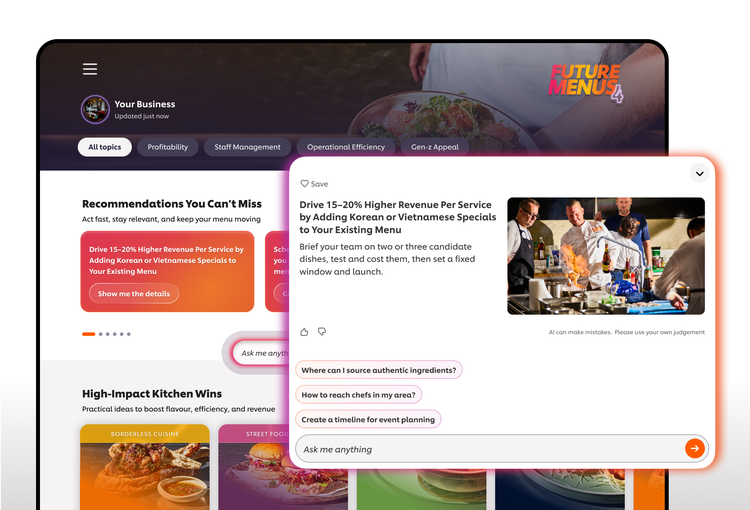

Tailored recommendations specific for your business
Get tailored recommendations and practical solutions powered by 2026 culinary trends

Downloadable toolkit with actionable tips
Access a toolkit tailored for your kitchen—no more one-size-fits-all downloads.

Actionable recommendations from industry trends
Unlock recipes, menu inspiration, and training designed to solve your real kitchen challenges and help you grow.
Trends That Matter
Last Year’s Influence
Check how Future Menus inspired kitchens worldwide to innovate and grow.
50%
of Gen Z reported trying more flavours in the past year while 14% of Baby Boomers said the same.
A new wave
of culinary creativity grounds dishes in local or familiar root — then elevates them with 10% global influence, from za’atar-laced marinades to ube-infused desserts.
68%
of diners under 40 now seek meals year while that reflect multiple cultures.
Trends impact
in food service
Take a peek at how chefs across the globe are sharpening their game with Future Menus.


"Don't be afraid to let the customer say what they want. Chefs always need to be ready for that to change and give what the customer wants''

Head Chef at The Duke of Sussex, UK

''You need to be adaptable. Earth is just getting smaller and smaller. We can access almost everything from another part of the world''

Chef at Tabure, UK

''We like to kind of get wacky with it, if you would. And this is where we put like our chef side of things''

Chef and owner at Santa Masa Tamaleria, US


Enter your business name to unlock personalised growth recommendations
We will use AI to create personalised recommendations